


Affiliate Disclosure As an Amazon Associate I earn from qualifying purchases. This post may contain affiliate links. For more details, refer to my Disclaimer page.
This rye sourdough bread recipe gives you a hearty, mildly tangy loaf with an earthy flavour that works for everything from a pastrami sandwich to soaking up the last of a winter stew. It uses a mix of bread flour and rye flour, which keeps the loaf workable for hand-shaping rather than the dense, paste-like dough you get from a 100% rye recipe.
The method is a standard sourdough process: autolyse, stretch and folds, bulk rise, overnight prove in the fridge, then bake. No commercial yeast. Total active time is around 30 minutes, spread over a day, with the dough doing most of the work on its own.
If you're new to rye, there are a few things it does differently to wheat flour, and a few common failures (gummy crumb, dense loaf, flat bake) that are easy to avoid once you know what causes them. Both are covered further down.
I bake this regularly and freeze sliced loaves for the week. It pairs particularly well with my cheddar and onion ploughman's sandwich and works as the base for a proper pastrami mustard sandwich.
If you are looking for bread dough styles and detailed instructions how to make it, try my bread dough calculator. This offers all weights and measures to get a great dough.

Rye sourdough is a tasty yet healthy brown bread. It is great for sandwiches, especially with pastrami and other cold meats. Sourdough uses a starter recipe which is made up of just flour and water and then left to ferment for a few days. Some people who find commercial yeasted bread sits heavily prefer sourdough because the longer fermentation breaks down more of the flour's starches before baking. This isn't medical advice, but if standard bread doesn't agree with you, a properly fermented sourdough is worth trying.
I make this bread quite often and then freeze the finished loaves once sliced. The cheese and onion ploughman's sandwich works particularly well with this bread.
Contents
Hydration and why rye sourdough is different
Rye flour is not just brown bread flour. It behaves very differently to wheat, and understanding why makes the rest of this recipe make sense.
Wheat flour gives bread its structure through gluten. Rye contains very little of the right kind of protein to form a proper gluten network. What it does have is a group of plant gums called pentosans, which absorb water far more aggressively than wheat starch. Pentosans are what make rye dough feel sticky and paste-like, and they're why a rye loaf can take on a lot more water than you might expect from looking at the dough.
This recipe runs at roughly 73% hydration when you account for the water in the starter. That sits at the lower, more workable end for a rye blend, which is why this loaf still shapes like a normal sourdough rather than going full paste. As a rough rule, for every additional 10% rye you add to a blend, push the water up by around 3%.
The other thing rye does differently is ferment faster. Rye contains active enzymes (mainly amylase) that break down starches. Without enough acidity in the dough, those enzymes keep working during baking and leave you with a gummy interior. A properly fed sourdough starter and a full bulk rise give the dough enough acidity to keep the enzymes in check. This is why a sluggish or under-fed starter shows up more obviously in a rye loaf than in a white sourdough.
For the maths on your own variations, my bread hydration calculator page works out the percentages for you.
Ingredients for rye sourdough
As with most of my sourdough bread recipes the ingredients are quite simple. The bread requires 2 types of flour (white and rye) and then water, salt and sourdough starter.
- Bread flour (white) - I stick to my same standard Shipton Mill flour. The main bread flour is milled grain and offers some good gluten stability for the base of the bread. Good gluten proteins mean a stronger dough and a better rise. This is an important factor when making sourdough bread.
- Rye flour - Experiment with different types of Rye. I find the water absorption varies on a vast scale depending on brand. Where the recipe may call for 280ml water, you might find it needs 300ml to get a workable dough. This is a similar 'issue' when using brown flour or wholemeal flour so take some time to learn how the liquid absorption works for you.
- Water - 30C tepid water works best. Achieve this by boiling the kettle and adding boiled water to cold water to achieve the approximate temperature.
- Salt - Any table salt will suffice. I opt for the 2% rule but you can go as low as 1% if you are on a reduced salt diet. See my bread hydration calculator page for more details.
- Sourdough Starter - I made a rye flour starter specifically for this. For more sourdough starter ideas take a look at my sourdough starter recipe post.
See recipe card for quantities.
Instructions to make Rye sourdough bread
All my sourdough recipes follow a similar set of instructions. You will find the process that works for you. If it doesn't work first time, try again. Keep trying until you get a consistent bread result. I promise you it is worth it.
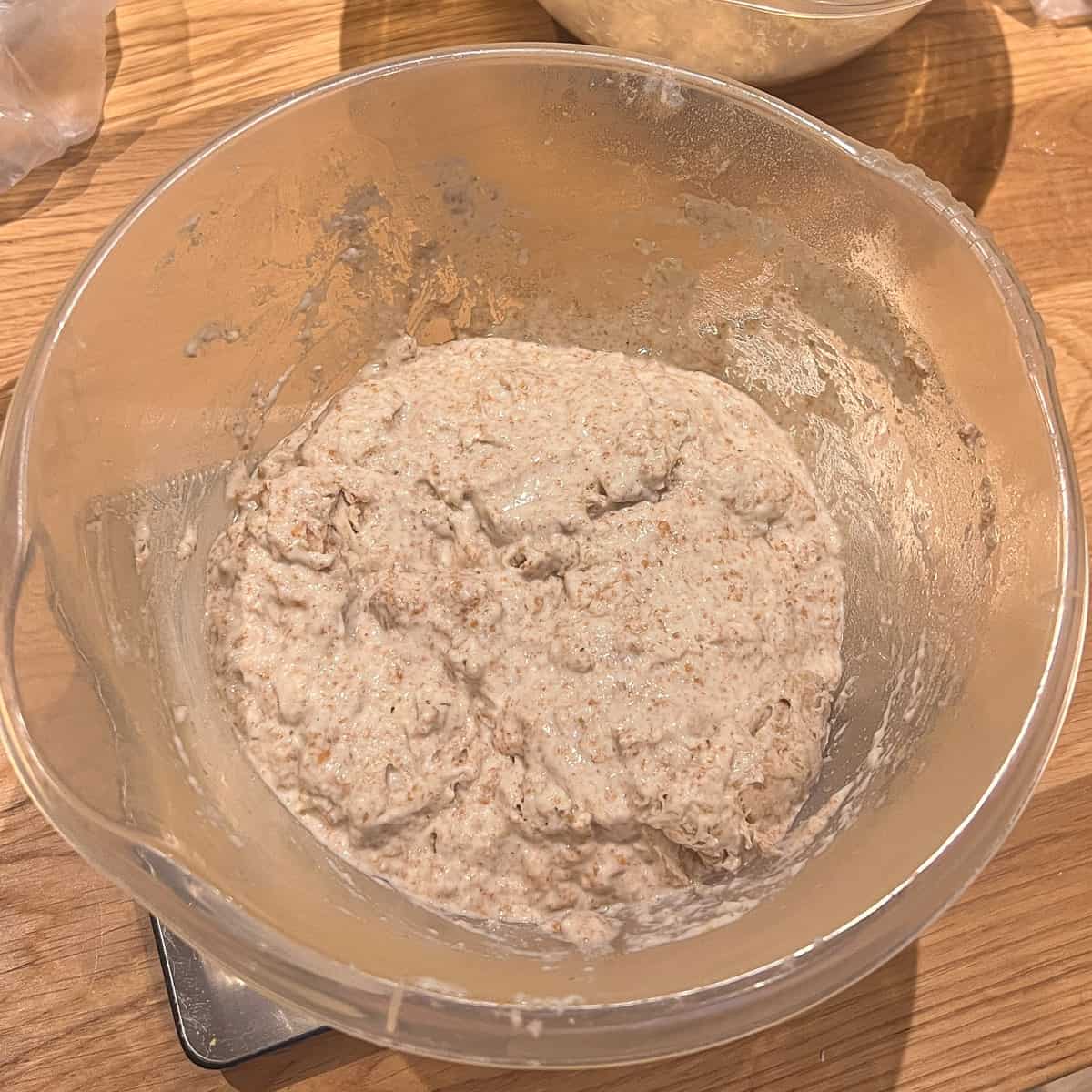
Combine the flour and water and mix. Leave for an hour to autolyse.
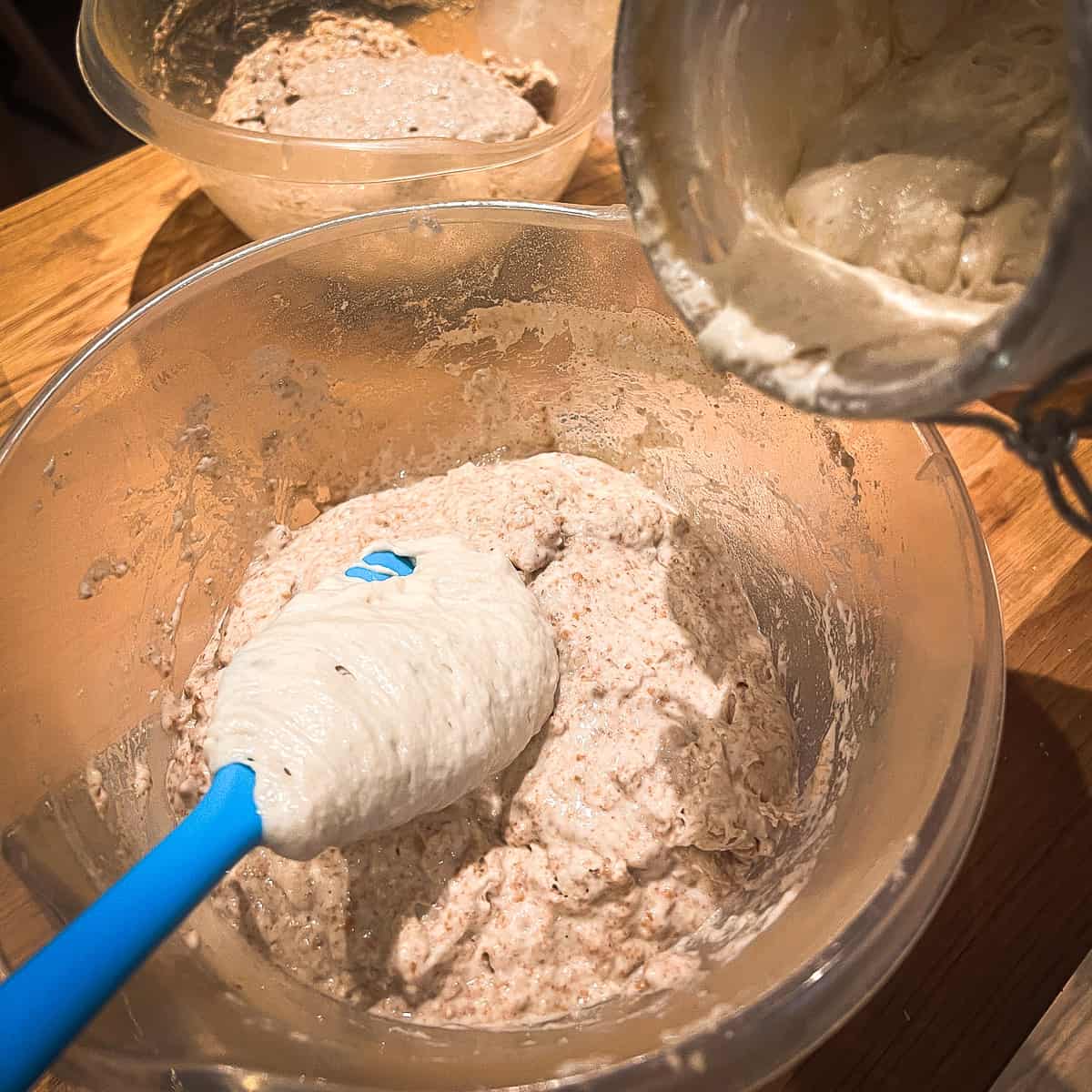
Mix in the sourdough starter. Leave for 30 minutes or so.
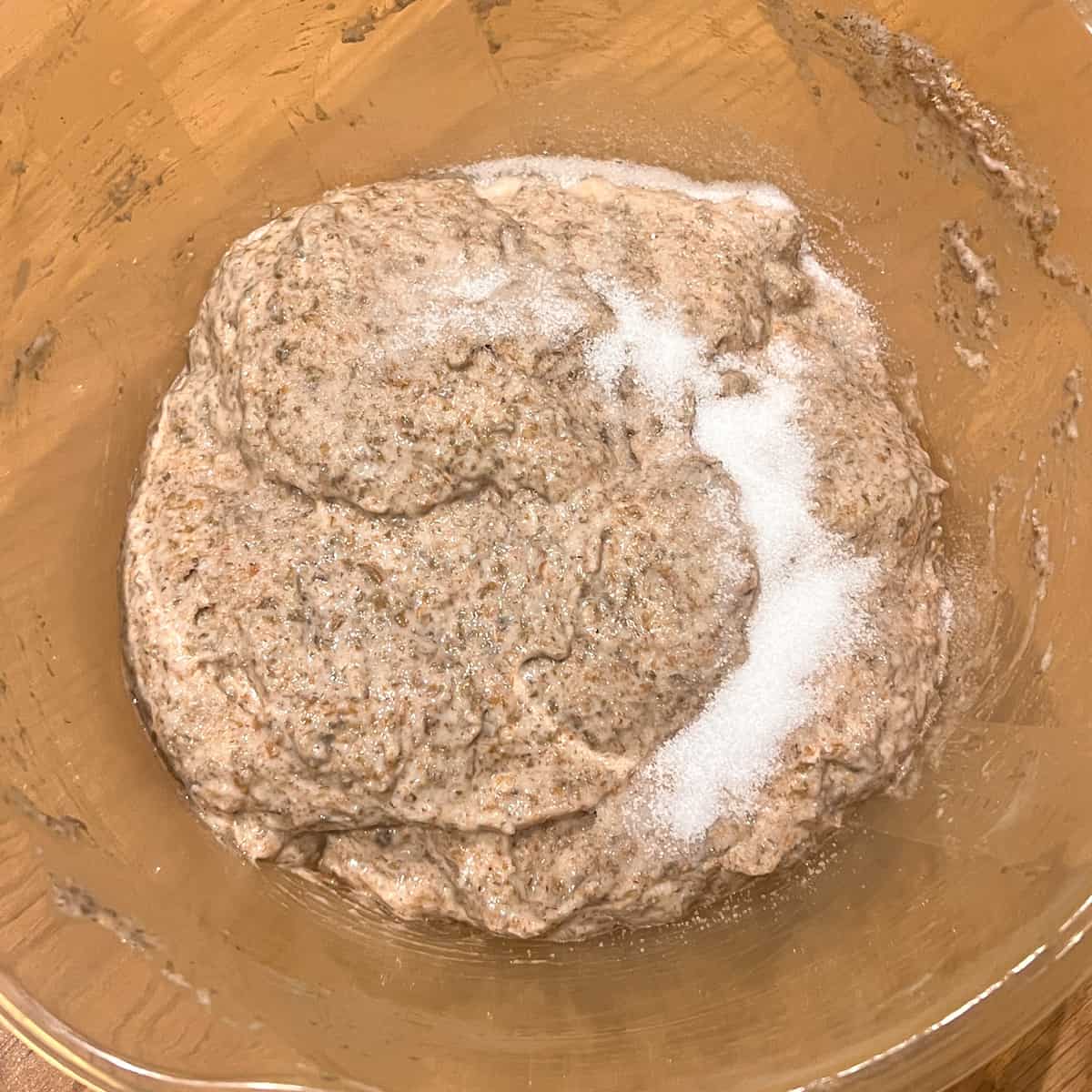
Add in the salt and then begin the stretch and folds.
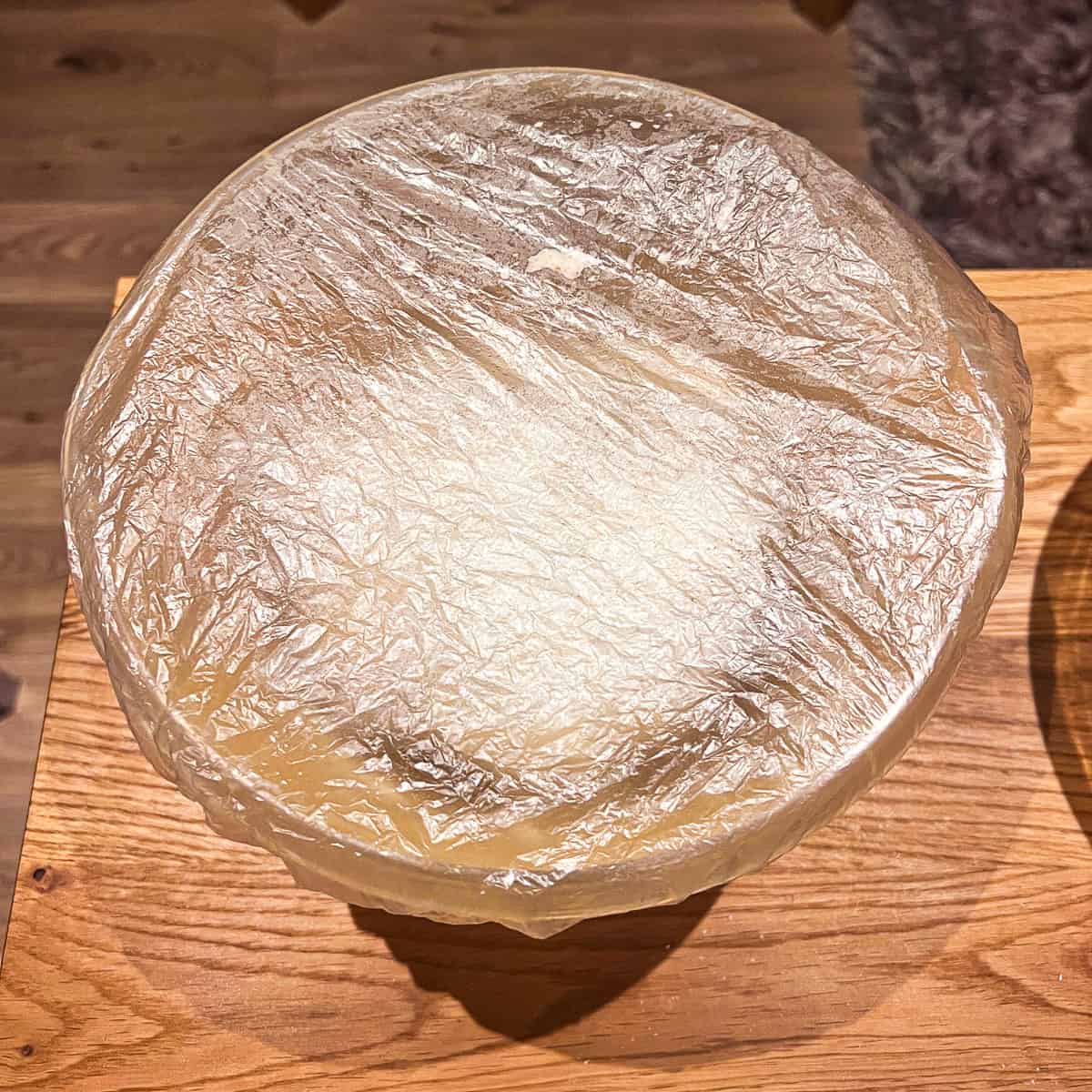
After all the stretch and folds are done, leave for the bulk rise for 3 - 8 hours.
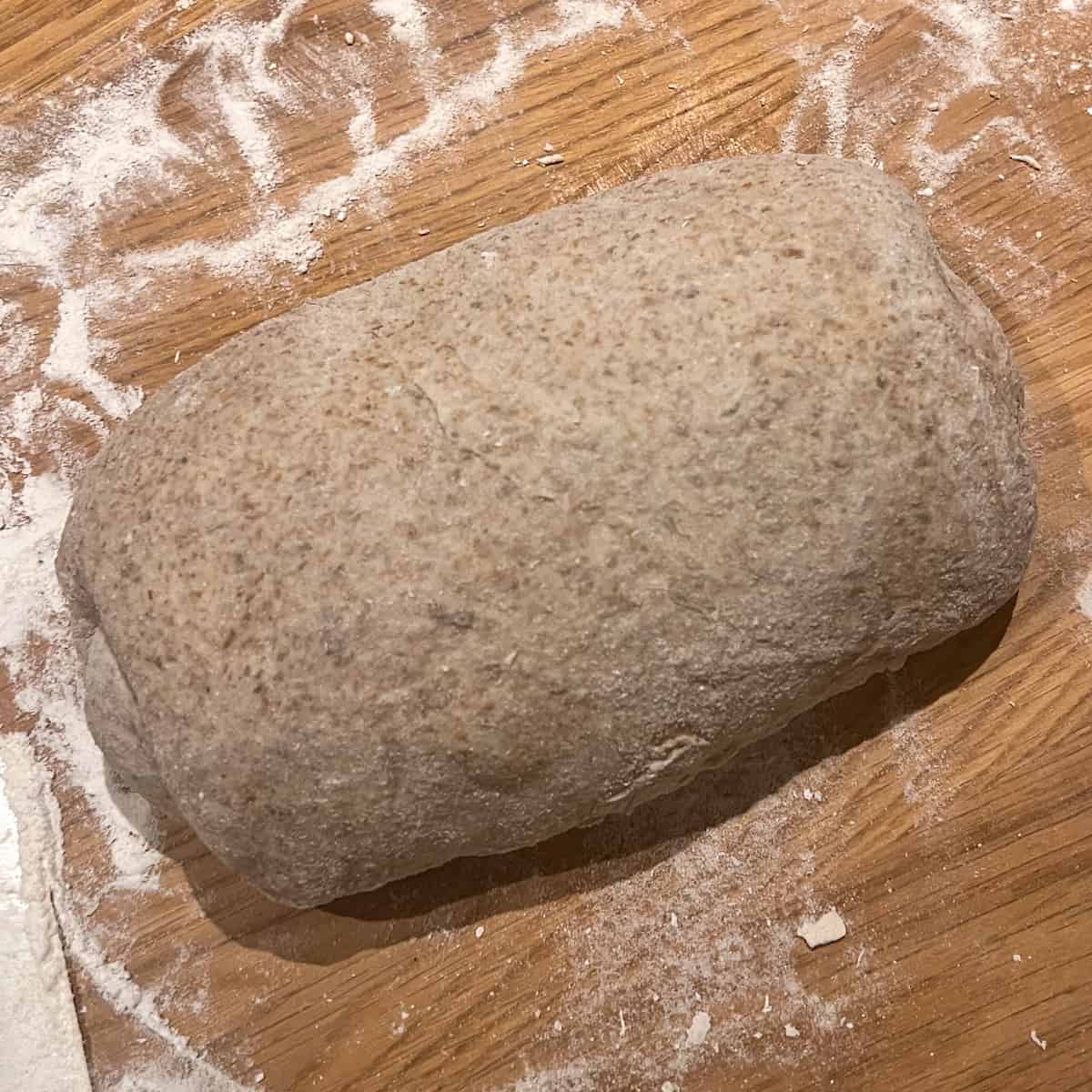
Shape the dough. Take some time to ensure a tight skin around when shaping as this will help with an even rise during baking.
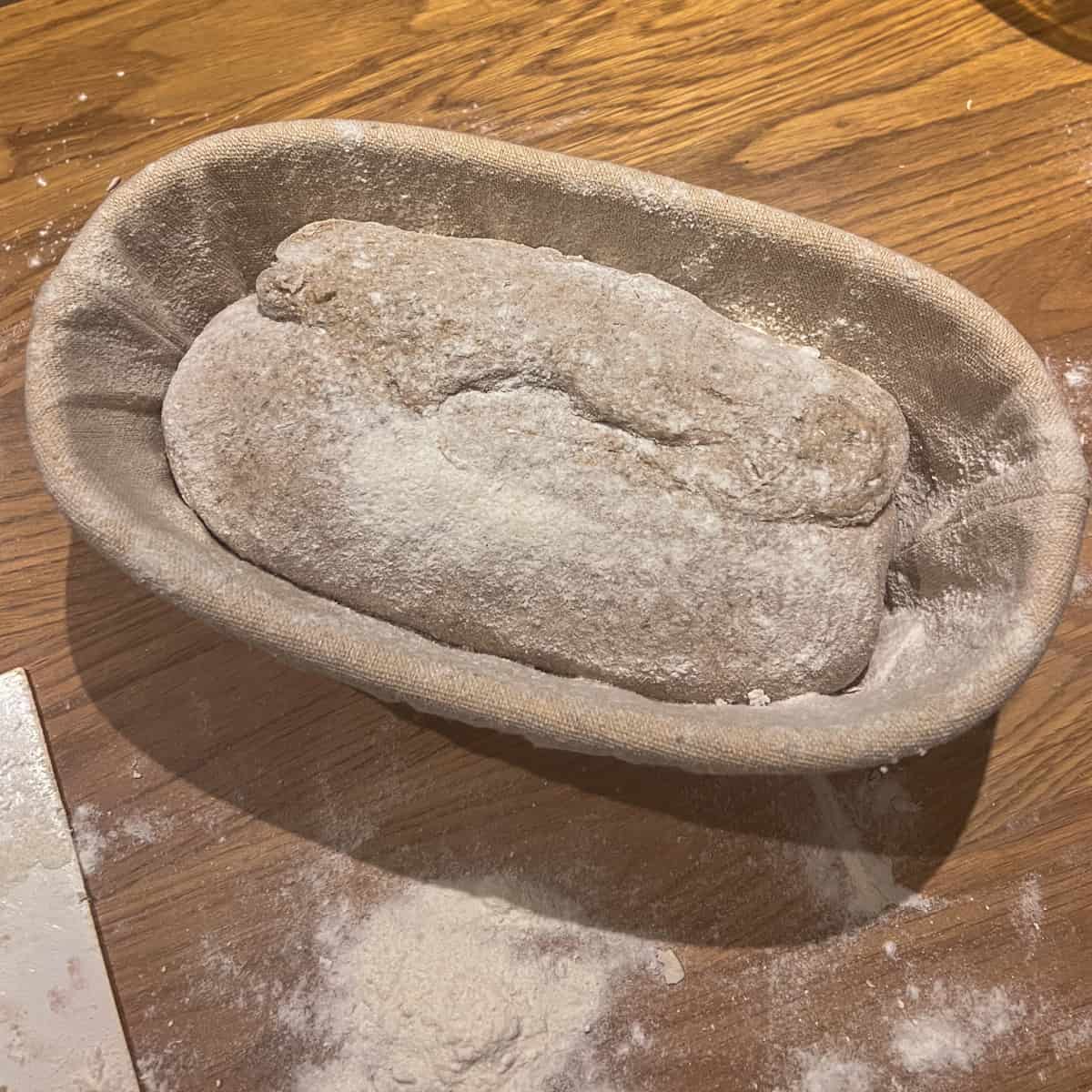
Put in the banneton and cover. Prove in the fridge overnight or up to 24 hours.
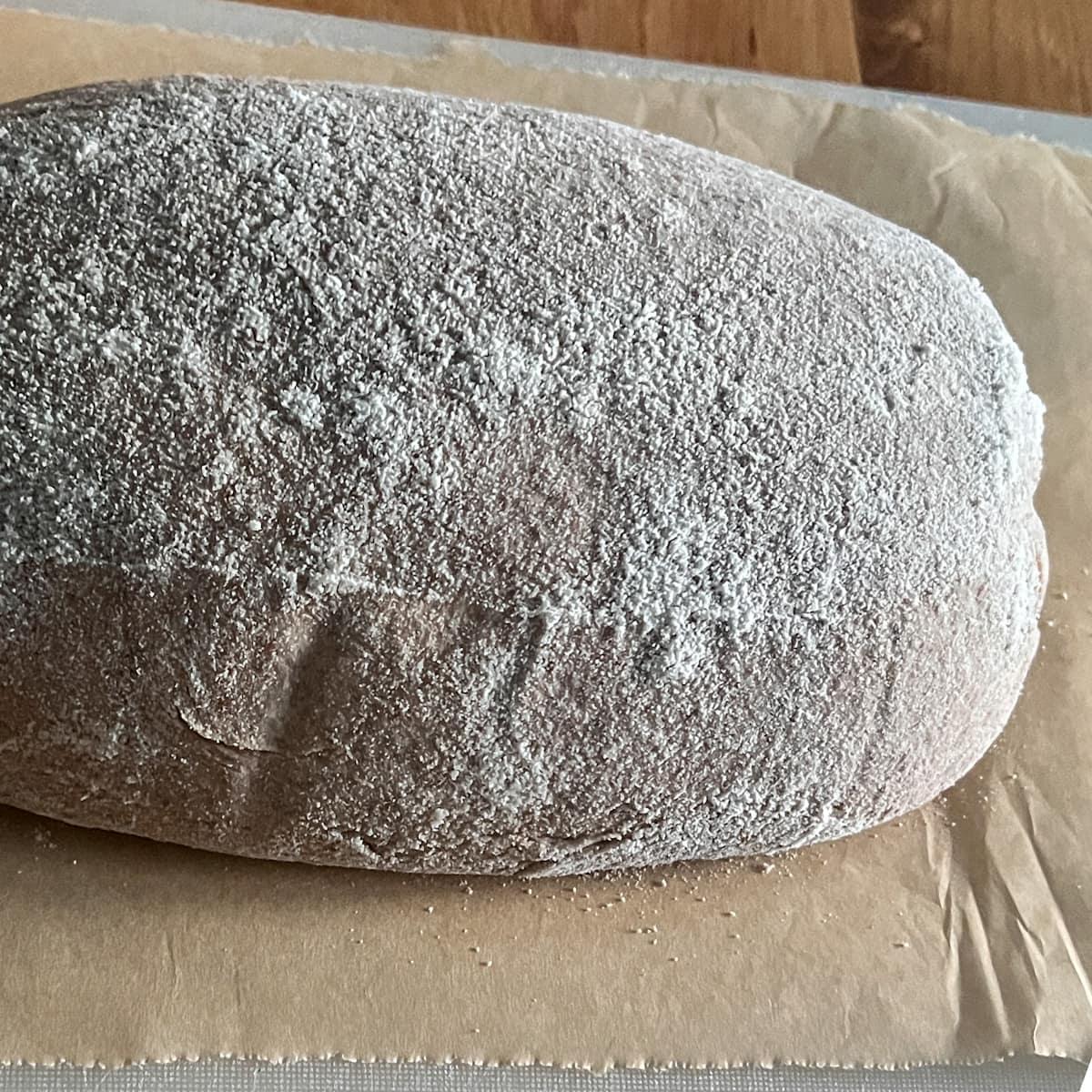
Turn out and score the top.
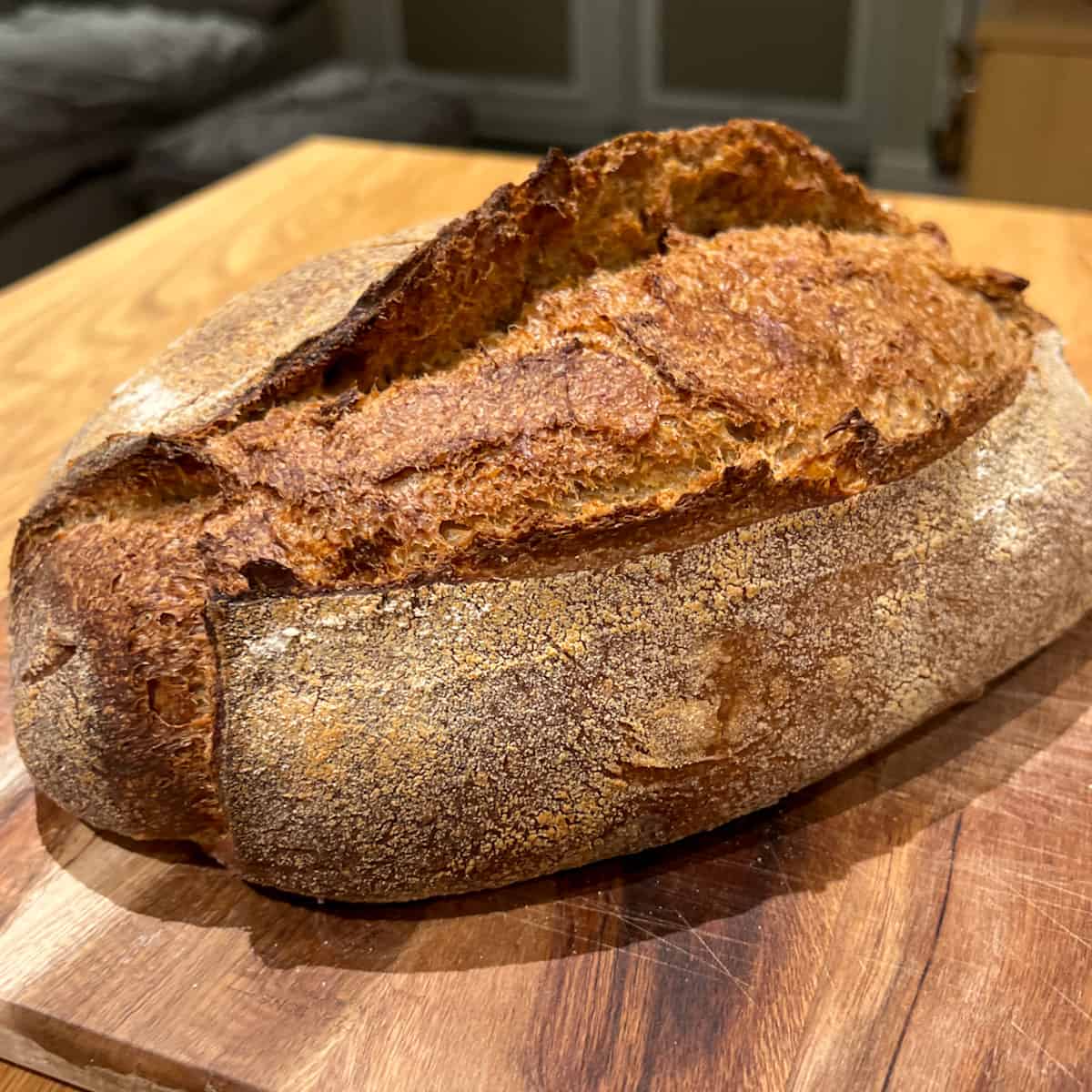
Bake at 200C for 30 to 40 minutes until the top is golden and the bottom is hollow sounding when tapped.
Stretch and folds when making sourdough
This is a key skill to learn in the world of sourdough. The process helps build gluten strength and gets things mixed in. It is an alternative to kneading bread and is far less effort. It just takes time.
One set of stretch and folds consists of:
- Pull the dough up one side and stretch (don't let it tear) an then tuck into the centre.
- Turn the bowl a quarter turn.
- Repeat the pull and stretch and tuck into centre.
- Repeat another 6 times so you have gone all the way around the bowl twice.
The above process will take about 20 seconds to do a full set of stretch and folds. In a normal bake, you'd typically do 4 sets of the above each 30 minutes apart. So would take about 2 hours to complete.
See my sourdough in the working day for a time line of how to fit this in around a typical 9 to 5 job.
Hint: Ambient temperatures drastically affect how long the process for making sourdough bread takes. If it's warmer it doesn't take anywhere as long as colder climates. Here in the UK, a bulk rise can take 2 hours in summer and 10 hours in winter!
Bulk rise fermentation making sourdough bread
The bulk rise takes place after the stretch and folds are completed. This is the time the starter really does its job and can being to rise the dough.
Check in on it after 2 hours and then every hour after then. Signs to know when the bulk rise is complete and the dough is ready for shaping:
- You'll see bubbles forming in the dough
- It will become bit more jelly like when wobbled.
- The dough will be nearer double in size/volume than when it started.
Shaping and Baking
There are a couple of items that will help you with the shaping and baking process. For shaping, get yourself a banneton to rest the dough in and also a dough scraper.
This will become an extension of your hand and really helps when handling the dough.
Top Tip: To avoid dough sticking to your hands when handling it, try rubbing your hands with olive oil before shaping the dough.
When ready to shape, have your banneton proving basket ready and dusted with rice flour to stop the dough sticking inside it during the proving process.
Cover the banneton with a shower cap or damp cloth and place in the fridge over night.
Top Tip: Having a basket dusted with rice flour stops the dough sticking. Using a different type of flour to the main dough stops the dough absorbing in that flour. Rice flour or semolina flour works well for dusting when making bread using bread flour.
Variations of Rye Sourdough Bread
The classic addition to a rye loaf is caraway seeds. If you're heading towards a Reuben sandwich, a German-style rye, or anything that wants that warm, slightly peppery note, caraway is worth trying. Around 1 to 2 teaspoons folded in at the salt stage is a sensible starting point. Toast them dry in a pan for 30 seconds first to bring out the oils, then let them cool before adding.
For a darker, sweeter loaf, swap 20ml of the water for black treacle. This shifts the flavour towards a Northern European style, similar to pumpernickel without the long low-temperature bake. The treacle deepens the crust colour and balances the rye's natural bitterness.
Other variations to try:
- Sunflower or pumpkin seeds folded in at the salt stage, around 50g
- Fennel seeds instead of caraway for a sweeter, anise-leaning flavour
- 10g of cocoa added to the flour for an unconventional very dark rye
- Brown wholemeal flour in place of the rye for a milder loaf with a similar method
If you want to explore other rye-based bakes, see my maple syrup rye sourdough bread for a sweeter, breakfast-leaning version, or the honey oat rye loaf for a softer everyday bake.
Why is my rye sourdough dense or gummy?
A wet, gummy band through the middle of an otherwise good-looking loaf is the most common rye sourdough failure. There are five usual causes.
The starter wasn't acidic enough. As covered above, rye enzymes keep breaking down starch during baking unless the dough has enough acidity to slow them. A sluggish or under-fed starter is almost always the root cause of gummy rye. Feed your starter for 24 to 48 hours before baking and use it at peak rise, when it has doubled and started to look domed.
You cut into it too soon. Rye loaves need to fully cool before slicing. The structure sets as the bread cools, and slicing warm rye will almost always show a gummy crumb. Wait at least 4 hours. For a higher-percentage rye loaf, leave it overnight.
Under-baked. A hollow tap is unreliable on rye. Use a probe thermometer and pull the loaf at 96 to 99°C internal temperature.
Too much rye, not enough water If you bumped the rye percentage but kept the water the same, the loaf will come out dense and short. Increase the water proportionally.
The bulk rise was rushed. Rye dough does not double the way a white sourdough does. Look for around a 30 to 50% increase in volume, a jelly-like wobble, and visible bubbles. If you shape too early, the loaf has no internal structure to expand into during the bake.
Which rye flour to buy in the UK
UK rye flour is sold under a confusing range of labels, and they're not all interchangeable for this recipe.
- Light rye (sometimes called white rye) has had most of the bran sifted out. It behaves closest to white bread flour, gives a milder flavour, and a softer crumb. Bacheldre and Marriages both stock light rye if you can find them.
- Wholemeal or wholegrain rye keeps the bran and germ. This is what most UK supermarket "rye flour" actually is, although the labelling is inconsistent. Doves Farm wholegrain rye is the easiest to find in Sainsbury's, Tesco, and Waitrose. Shipton Mill organic rye sits in the same bracket and is what I use most often.
- Dark rye or stoneground rye is the most assertive. It absorbs the most water and has the strongest flavour. Bacheldre stoneground wholegrain rye is excellent if you can get it.
Where to buy in the UK:
- Supermarkets (Sainsbury's, Tesco, Waitrose, Asda) carry Doves Farm in the home baking aisle
- Online specialists like Bakery Bits, Amazon, Shipton Mill direct, and Matthews Cotswold Flour stock the full range
Useful equipment for making sourdough
Equipment can have a big impact on how a recipe turns out. Stone bakeware takes longer to heat up than metal baking trays but retain heat for longer. Consider a baking stone when cooking the bread to crisp up the bottom.
Storing rye sourdough bread
Sourdough bread does last a day or two (if it's not eaten first!) however the fresher the better. If you want to keep it longer you can freeze it.
I recommend slicing the bread before freezing it, place the bread in a freezer bag and then you can take out the slices you need to use while others remain frozen. It will keep well in the freezer for up to 3 months.
If storing bread on the counter or in a larder, I recommend a fabric bread bag which will keep it out of the general atmosphere but still allow the bread to last longer. A bread bin is also a useful item for this to help keep bread fresher for longer.
FAQ
When you feed your starter, it will be twice the size and bubbling ready for action within about 4 hours if it's ready to go.
Of course. This is the fun of sourdough. Try mixing it up and using normal starter with rye flour. Or make a rye starter and see how it reacts to normal flour.
My recommendation is yes. With the starter, consistency is key. While it will work, it might take some getting used to. So stick to the same flour each time when feeding a starter.
When you feed your starter, it should double in size and be actively bubbling within around 4 hours. If it's sluggish, give it another feed and wait.
Yes. A wheat-fed starter works fine in this recipe because only around 37% of the total flour is rye. For higher-percentage rye loaves, a dedicated rye starter performs better.
Yes. Consistency makes the starter more predictable. Switching flours mid-feed slows things down for a few cycles.
The two most common causes are an under-fermented bulk rise and slicing the loaf before it has fully cooled. Rye needs more time on the bulk and a longer cool than a wheat sourdough. See the dense-or-gummy section above for the full list.
You can, but the loaf will be much denser and the crumb tighter. The bread flour provides the gluten structure that holds the open crumb together. If you want a 100% rye loaf, expect a brick-shaped pan loaf with very little oven spring.
Around 3 days in a fabric bread bag or bread bin at room temperature, and up to 3 months sliced in the freezer. Rye keeps slightly better than white sourdough because of its higher moisture content.
This recipe gives a mild, earthy flavour with a gentle tang from the sourdough fermentation. It's far less assertive than a 100% rye loaf and works well for sandwiches, toast, and soups.
Yes. Fold 1 to 2 teaspoons of caraway seeds, or up to 50g of mixed seeds, in at the salt stage. Toasting seeds briefly in a dry pan first brings out more flavour.
Light rye has the bran removed, behaves closest to white flour, and gives a milder flavour. Wholemeal or wholegrain rye keeps everything, absorbs more water, and gives a stronger taste. Dark rye is the most assertive of the lot.
Yes. Grease a 2lb loaf tin and shape the dough into an oval rather than a round dough. The final prove can be done in the tin. Bake covered with foil for the first 20 minutes to retain moisture, then uncover for the final 20.
Pairing rye sourdough breads
These are my favourite dishes to serve with Rye sourdough bread:



The Recipe
Rye Sourdough Bread
Equipment
Ingredients
- 250 g Bread flour
- 150 g Rye flour
- 280 ml Water luke warm
- 8 g Salt
- 75 g Starter
Instructions
Making the dough
- Mix together the water, bread flour and the rye flour then leave it for an hour. This is the autolyse time which helps build strength with the gluten formation in the bread dough.250 g Bread flour, 150 g Rye flour, 280 ml Water
- Add in the sourdough starter and carefully mix in. Let the dough settle and rest for 30 to 45 minutes.75 g Starter
- Add the salt and then begin the stretch and folds. Do one set of stretch and folds every 30 minutes over the course of 2 hours.8 g Salt
Bulk prove
- Cover the dough and leave for 2 hours, up to 8 hours (depending on climate.)
Shape and prove
- Once doubled in size with bubbles, tip out the dough and shape. Place in a prepared banneton basket. Put it in the fridge to prove over night (up to 24 hours).
Bake
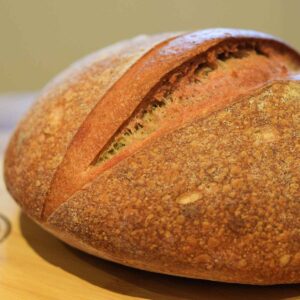
- Preheat your oven.If using a baking stone or Dutch oven you must preheat it for at least 30 minutes. If you want, you can just use a normal baking tray instead. Just make sure it is pre-heated.Also - place a baking tray in to the bottom of the oven to preheat too (this is going to have water in it to create steam).Flip your banneton onto some baking paper and score the sourdough as per the picture. Use a sharp knife or baking lame to achieve this. If you want you can do a design on it too.
- Just before you put the bread in the oven, pour some boiling water into the baking tray in the oven to create steam.Put your bread in on the baking stone or on the tray. Bake for 30 to 40 minutes.For a Dutch oven, you should bake covered for 20 minutes and then uncover and bake for another 25 minutes.
- You can tell it is ready by looking for a brown crust on the top and a hollow sound when the bread is tapped underneath. For best accuracy, use a probe thermometer and pull the loaf when the internal temperature reads 96 to 99°C. The hollow tap test is a reasonable backup, but rye sets up differently to wheat and can sound hollow before it's fully baked through.
Slicing Rye - Important
- Allow the loaf to cool fully on a wire rack, at least 4 hours, before slicing. Cutting into rye too soon will leave the crumb gummy even if the bake was correct.
Notes
Nutrition
More posts like this


2 responses to “Rye Sourdough Bread”
-


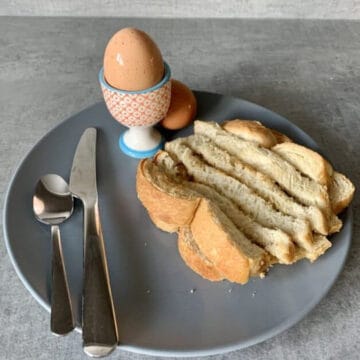
Made this for accompaniment to a Sunday breakfast. Seems healthier and still tasty. -
I found this recipe by accident looking for a way to use up some old flour. So glad I did!


Leave a Reply